 Skip to main content Skip to footer
Security clearance is the first step in any company formation in Bahrain. Before MOIC will process your CR application, the National Passports and Residency Affairs (NPRA) authority must clear every foreign shareholder. When that clearance comes back as “defected,” the CR application cannot move forward.
A defected clearance is not a permanent ban. In most cases it is a solvable problem — but only if you know what caused it and what the resolution path looks like.
What Is Security Clearance for CR?

Every foreign national applying to be a shareholder in a Bahrain-registered company must pass an NPRA security clearance check before the company can be registered. This check runs through Sijilat as part of the standard CR application process.
The clearance verifies that the applicant has no unresolved immigration violations in Bahrain, no active travel bans, no outstanding fines, and no entry prohibitions that would make granting them a business registration inappropriate.
NPRA typically processes security clearances within 3-5 working days. The result comes back through Sijilat as either Approved, Pending, or Defected.
What Does “Defected” Mean?

A defected security clearance means NPRA has identified an issue in the applicant’s records that prevents automatic approval. It is not a rejection of the company formation application – it is a hold on the security clearance step specifically.
Common reasons a security clearance returns as defected:
1. Previous overstay or immigration violation: If the applicant has previously overstayed a visa in Bahrain, entered on an invalid visa, or breached visa conditions, this appears in NPRA records. Even a minor overstay from years ago can trigger a defected result.
2. Outstanding fines or LMRA violations: Unpaid LMRA fines from a previous work permit, unpaid GOSI contributions from a prior employer, or outstanding labour violations under a previous sponsor can cause a defected clearance. The applicant may not be aware these exist – checking through LMRA’s portal before applying is worth doing.
3. Active travel ban: A court order, financial dispute, or regulatory action from a previous business relationship in Bahrain can result in a travel ban that blocks clearance. These are sometimes the result of disputes the applicant thought were resolved.
4. Name or passport discrepancy: Applying under a name that doesn’t exactly match NPRA records – different transliterations of Arabic names, changed names after marriage, or passport numbers that have been updated – can cause a system mismatch that returns as defected even though no actual restriction exists.
5. Residency status conflict: Applying for CR while currently holding a work visa in Bahrain (sponsored by a different employer) without having completed the required 12-month tenure or obtaining an NOC can trigger a defected result at the security clearance stage.
6. Incomplete prior CR closure: If the applicant previously held a CR in Bahrain that was cancelled “by law” rather than through a proper voluntary liquidation, outstanding obligations from that CR may be flagged.
How to Resolve a Defected Security Clearance

The resolution process depends on the cause. There is no single fix – each defect type has a different path.
Step 1 – Identify the specific reason: Request clarification from NPRA through Sijilat or in person at an NPRA service centre. NPRA does not always provide a detailed explanation in the Sijilat portal result, but a direct enquiry usually surfaces the specific block.
Step 2 – Address the underlying issue:
- Outstanding fines: Pay through the relevant authority (LMRA, NPRA, courts) and obtain a clearance certificate
- Overstay or immigration violation: Apply for a formal waiver or amnesty through NPRA – these are granted on a case-by-case basis
- Name mismatch: Provide official documentation (birth certificate, passport with name change records, legal name declaration) to NPRA for record correction
- Travel ban: The ban must be lifted at source – this typically requires legal assistance if the ban relates to a court order or commercial dispute
- Prior CR obligations: Clear outstanding CR-related obligations through MOIC and obtain confirmation of clearance
Step 3 – Resubmit the security clearance application: Once the underlying issue is resolved, resubmit through Sijilat. A fresh clearance application processes within the standard 3–5 working day window.
How Long Does Resolution Take?
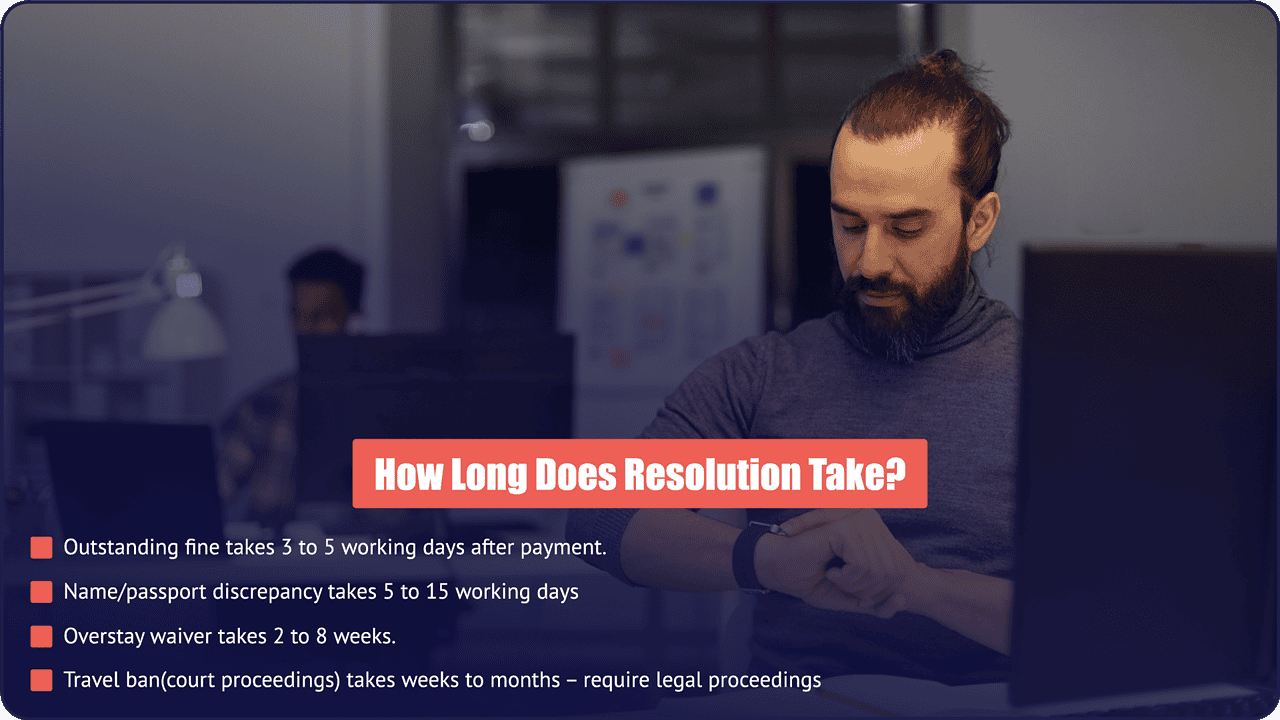
Resolution time varies significantly based on the cause:
| Cause | Typical Resolution Time |
|---|---|
| Outstanding fine (confirmed and paid) | 3–10 working days after payment |
| Name/passport discrepancy | 5–15 working days for record correction |
| Overstay waiver | 2–8 weeks depending on NPRA caseload |
| Travel ban (court-related) | Weeks to months — requires legal process |
| Prior CR obligations | 5–20 working days after MOIC clearance |
The most important thing is not to reattempt the Sijilat application before the underlying issue is resolved. Repeated defected clearances can flag the application as problematic and slow the process further.
Can We Handle This for You?

PI Startup Advisory manages security clearance issues as part of our company formation service. We identify the specific defect reason, coordinate the resolution with NPRA or the relevant authority, and resubmit the application when the clearance is ready to proceed.
This is one of the most time-sensitive parts of the formation process – a defected clearance that isn’t addressed properly can delay the entire registration by weeks.
Contact us to discuss your situation or call +973 1311 8811.
For the full company formation process, read our company formation in Bahrain guide.


