Skip to main content Skip to footer
Bahrain is one of the few places in the world where a foreign investor can own 100% of a company, pay zero corporate income tax, receive dividends without withholding tax, and sell assets without capital gains tax — all legally. That is not a marketing claim. It is the actual tax code.
This guide covers every tax that applies to businesses in Bahrain: what rates apply, who is affected, the VAT system, the new DMTT for large multinationals, and what this means practically for a foreign investor setting up a company.
Key Tax Rates & The Real Advantage
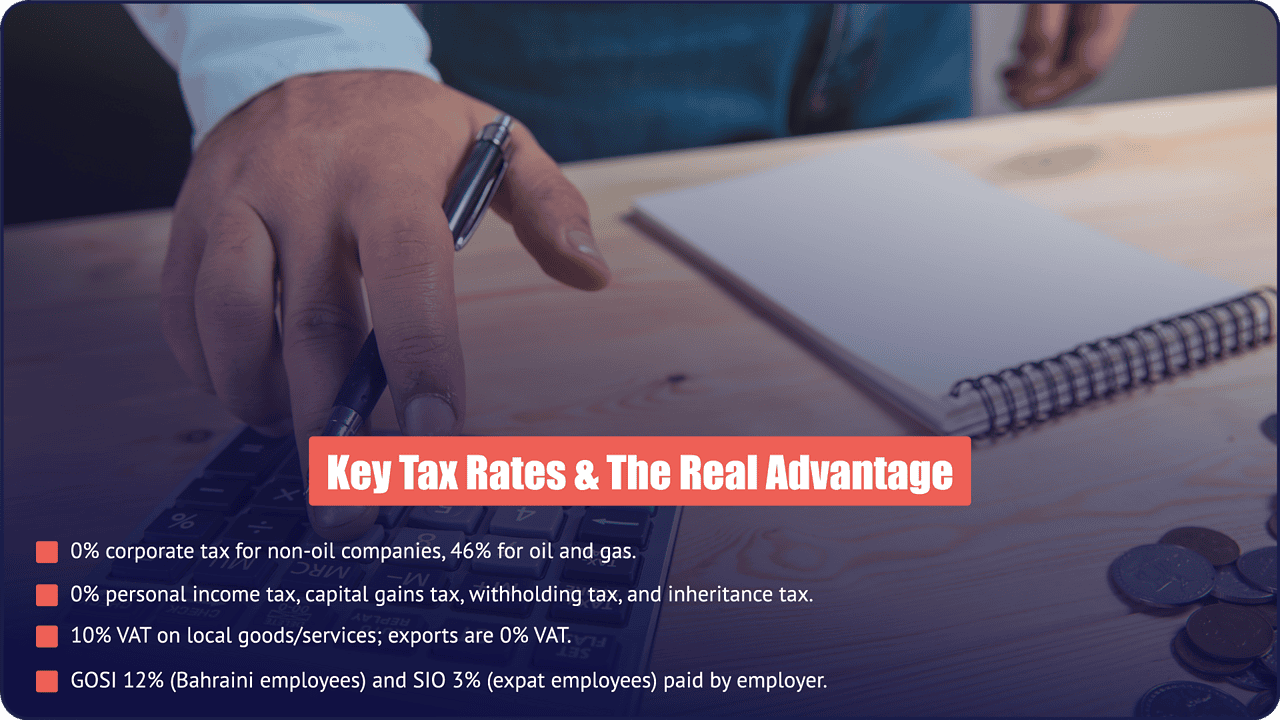
As I have mentioned before, most companies in Bahrain benefit from 0% corporate tax, no personal income tax, no capital gains tax and withholding tax. Bahrain applies 10% value added tax (VAT) on local sale while apply no tax on exported service, which benefits international clients. The oil and gas sectors are considered a major national resource; that is why it is an exception to this policy. Companies operating in these sectors are subject to a 46% corporate tax.
Following table summarizes each tax type in Bahrain.
| Tax Type | Rate | Applies to |
|---|---|---|
| Personal income tax | 0% | All individuals including expats |
| Capital gains tax (individual) | 0% | All individuals |
| Corporate income tax (non-oil) | 0% | All non-petroleum companies |
| Corporate income tax (oil & gas) | 46% | Oil, gas & petroleum companies |
| Domestic Minimum Top-up Tax (DMTT) | 15% | Multinational groups with global revenues ≥ EUR 750M |
| Value added tax (VAT) | 10% | Most goods & services |
| Withholding tax | 0% | Dividends, interests, royalties |
| Inheritance tax | 0% | All estates |
| Wealth tax | 0% | All individuals |
| Stamp duty | 0% | Property and documents transactions |
Who Administers Taxes?
The National Bureau of Revenue (NBR) is responsible for:
- Registering businesses for Value-Added Tax (VAT), Excise Tax, and Additional Minimum Tax.
- Checking the accuracy of submitted declarations.
- Collecting the outstanding amounts.
- Reviewing complaints.
- Monitoring and taking enforcement actions to ensure compliance.
Value Added Tax (VAT)
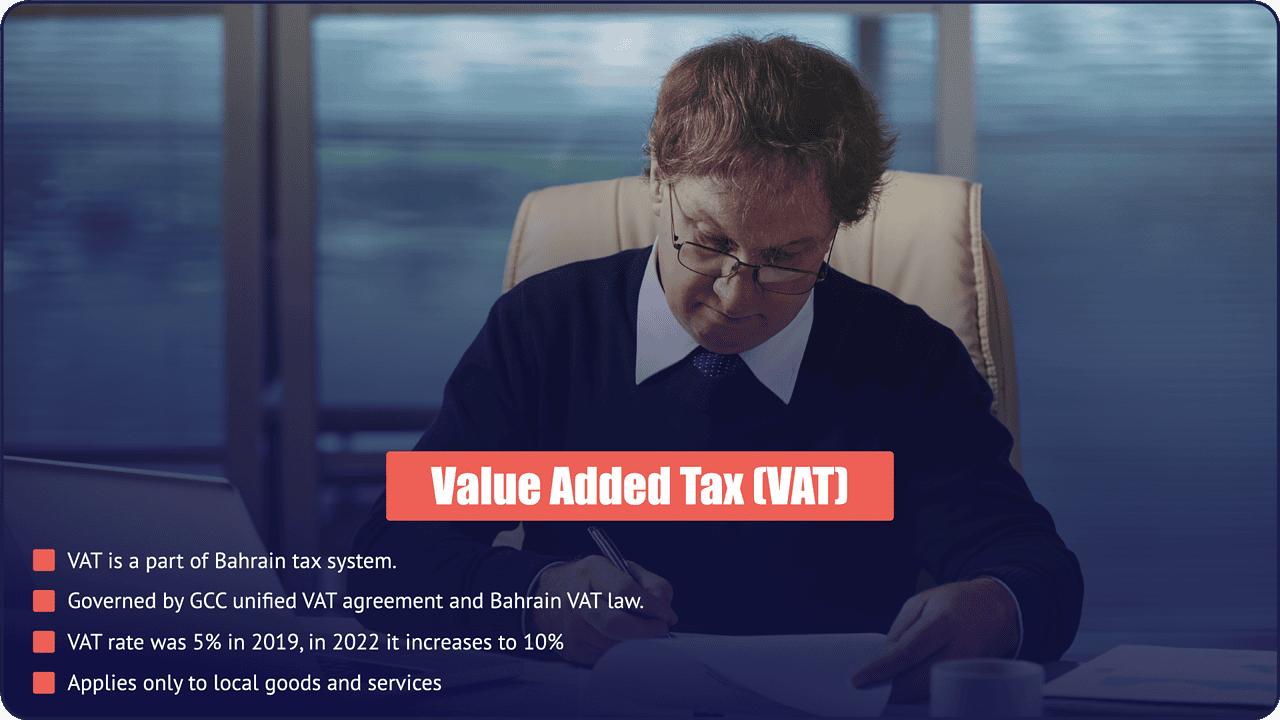
Value added tax (VAT) is part of the Bahrain’s tax system. It is governed by the GCC Unified VAT Agreement and the Bahrain VAT Law (Decree-Law No. 48 of 2018). It was introduced in 2019 to help generate revenue from different sources and reduce reliance on oil.
If you run business in Bahrain, it is necessary to understand how VAT applies to your goods and services – including when to register, how to file returns and what records to keep. Most businesses that earn above the mandatory threshold are required to register and charge VAT on taxable supplies. These Businesses must also keep clean records and submit returns on time.
Value Added Tax Rate
The VAT tax was introduced in 2019 at a rate of 5%, before increasing to 10% in 2022. The standard rate applies to most goods and services, though some qualify for exemptions or a 0% rate.
How does VAT work in Bahrain
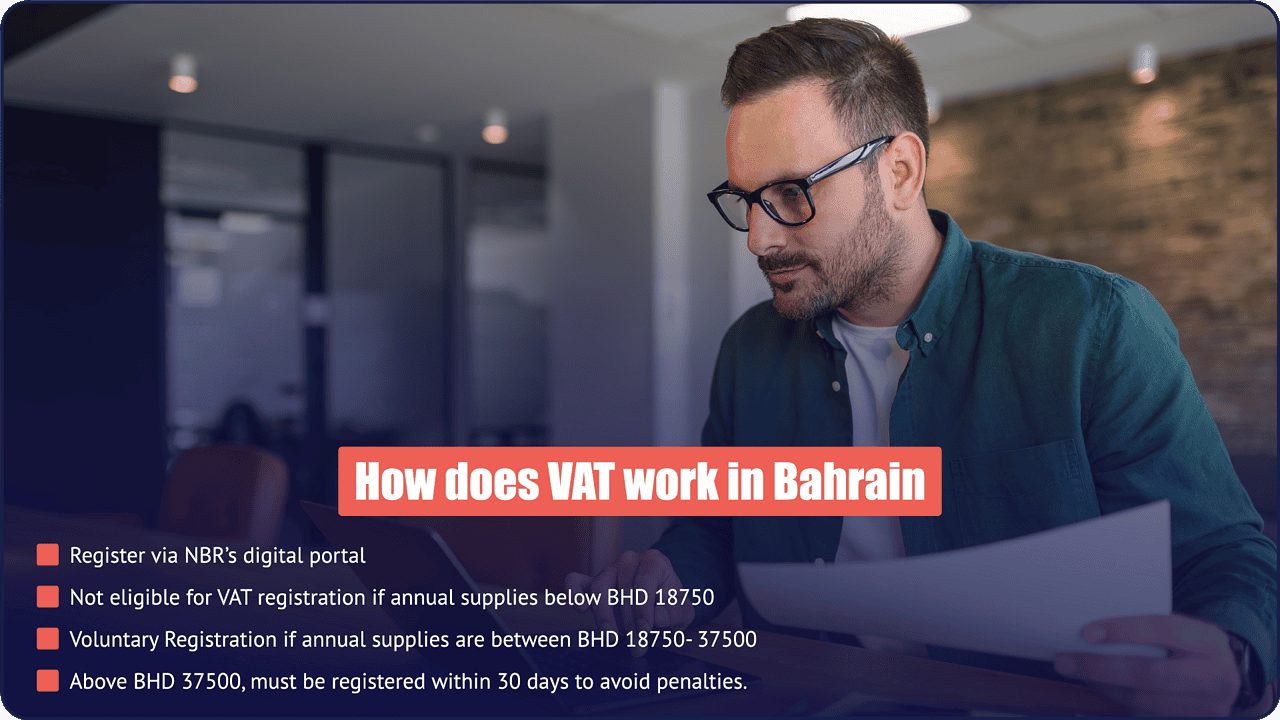
The good news is that registering for VAT in Bahrain is not complicated. You can register with the National Bureau of Revenue NBR’s digital portal which is fully operational and has clear guidelines in place. The process is easy if you know exactly what to prepare.
VAT registration criteria based on taxable supplies
The VAT registration depends on taxable supplies. According to National Bureau of Revenue (NBR), the following are the criteria for VAT registration:
If your annual supplies in next 12 months are less than BHD 18,750 then you are not eligible to register yourself for VAT. But if your annual supplies exceed 37,500 then it is mandatory to register yourself for VAT. If the annual supplies lie between BHD 18,750 and BHD 37,500 then you have a choice whether you register for it or not.
Note: if you fail to register within 30 days of exceeding the mandatory threshold you will get penalties from the NBR.
Documents required for VAT registration in Bahrain
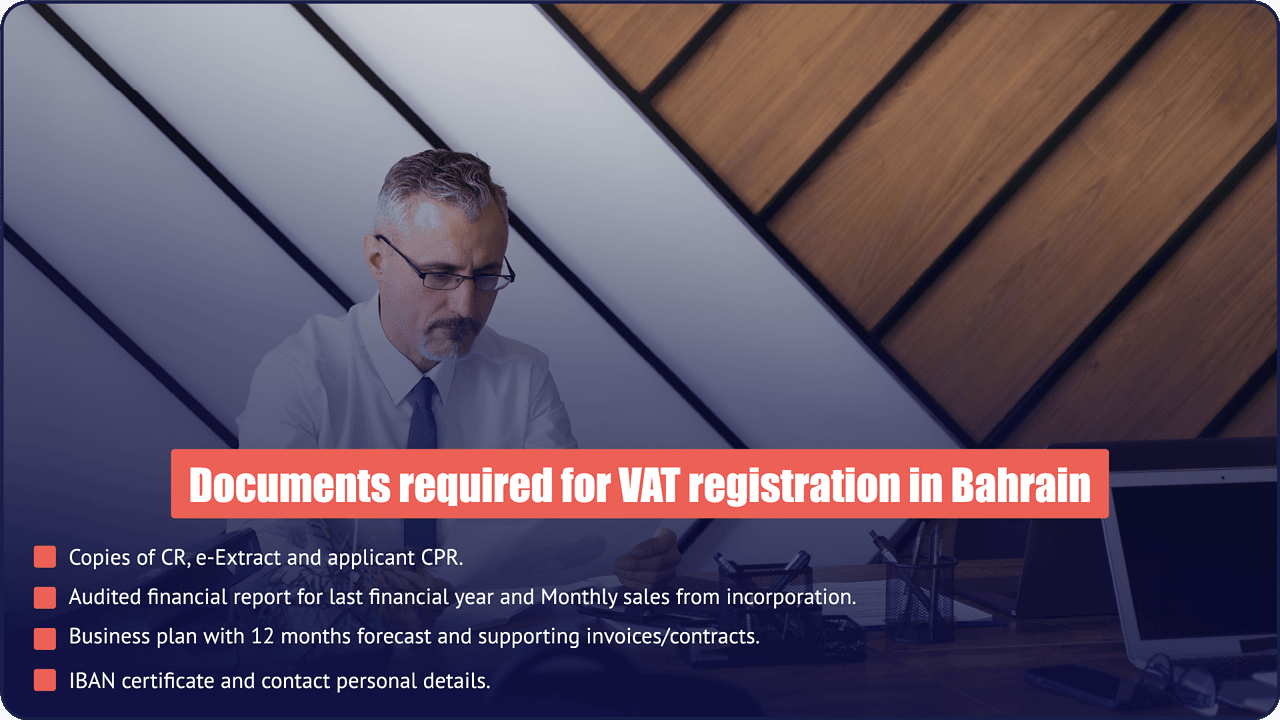
For VAT registration in Bahrain following are the required documents:
- Copy of CR (e-Certificate).
- Copy of e-Extract.
- Copy of applicant CPR.
- Audited financial report for last financial year (for companies more than 2 years old).
- Monthly sales from the date of incorporation to date.
- Business plan with a clear forecast of next 12 months taxable, zero-rated, and exempt supplies.
- Explanation of exempt and zero-rated supplies on company’s letterhead (if any).
- Purchase and Sales invoices, contracts, and other supporting documents proving registration eligibility.
- IBAN certificate or Bank Statement.
- Letter from company mentioning the contact person details such as Name, CPR, Phone & Email address.
Why Bahrain’s Tax System Makes It One of the Best Places for Business in the Gulf
Bahrain offers a powerful combination of tax benefits:
- Zero personal income tax
- Zero corporate tax for most sectors
- Zero capital gains tax
- Zero withholding tax
It means business owners keep more of what they earn than in almost any other country.
As an entrepreneur, if you are used to paying corporate tax on profits and then personal income tax on dividends, operating through a company in Bahrain fundamentally changes the financial equation.
10% VAT is the only tax rate which Bahrain charges. But even this is low compared to:
- 15% VAT rate in Saudi Arabia
- Most European countries (higher standard rates)
For business owners who want to take advantage of this tax environment formally, the first step is establishing a properly registered Bahraini company.
Domestic Minimum Top-up Tax (DMTT) – New from 2025
The zero-corporate-tax picture for Bahrain changed for one specific group of businesses in 2025. Royal Decree-Law No. 38 of 2025 introduced a Domestic Minimum Top-up Tax (DMTT) effective 1 January 2025.
Who it applies to: Multinational enterprise (MNE) groups with consolidated global revenues of EUR 750 million or more in at least two of the four preceding fiscal years.
What it is: A top-up tax of 15% on the excess profit of constituent entities in Bahrain, designed to bring Bahrain’s effective tax rate for large MNEs in line with the OECD’s Pillar Two global minimum tax framework. Bahrain is implementing this to remain compliant with international tax standards while maintaining its zero-tax environment for businesses below the threshold.
Who it does NOT apply to: The overwhelming majority of businesses in Bahrain — SMEs, WLL companies, consulting firms, trading companies, and most foreign-owned businesses. The EUR 750 million global revenue threshold affects only large multinationals. If your company’s global group revenue is below this threshold, the DMTT does not apply to you and your Bahrain entity continues to enjoy a 0% corporate tax rate.
Practical implications for most investors: For the typical foreign investor registering a WLL in Bahrain — whether an individual entrepreneur, SME, or regional business — the DMTT is irrelevant. Your effective corporate tax rate in Bahrain remains 0%.
For investors who are part of large multinational groups approaching or exceeding the EUR 750M global revenue threshold, the DMTT needs to be factored into group tax planning. The filing obligation, calculation methodology, and substance requirements under the DMTT are separate from VAT and ESR filings.
Is Bahrain a Tax Haven?
It is easy to understandable that Bahrain is frequently described as a tax haven in the Gulf context. Why? Because of zero personal income tax, zero corporate tax for most businesses, and zero capital gains tax.
Moreover, Bahrain is not listed as a harmful tax jurisdiction by the Organization of Economic Co-operation and Development OECD or Financial Action Task Force FATF because:
- It follows transparent financial reporting standards
- It has signed numerous tax information exchange agreements with other countries
- It operates a regulated banking and financial system
In short, the tax advantages in Bahrain are the result of deliberate policy, not secrecy. It’s a highly attractive destination for you and your business if you want to manage your tax obligations wisely.
For foreign investors registering a company in Bahrain, understanding the tax structure before you form is important – particularly which of your activities might trigger VAT registration or, for larger groups, DMTT obligations.
PI Startup Advisory advises on the full post-registration compliance picture. For company formation, see our company formation in Bahrain guide. For VAT registration as a service, see our VAT registration service.
Contact us for a free consultation or call +973 1311 8811.